
School Budget Excel Template – Free NZ Guide (2026)
Accounting & GST
Body Corporate Operating Budget Excel Template NZ
Plan NZ body corporate expenses, GST, levies and supplier costs with a practical operating budget Excel template.
2026-08-07
396 downloads
4.8/5 average rating
Download template
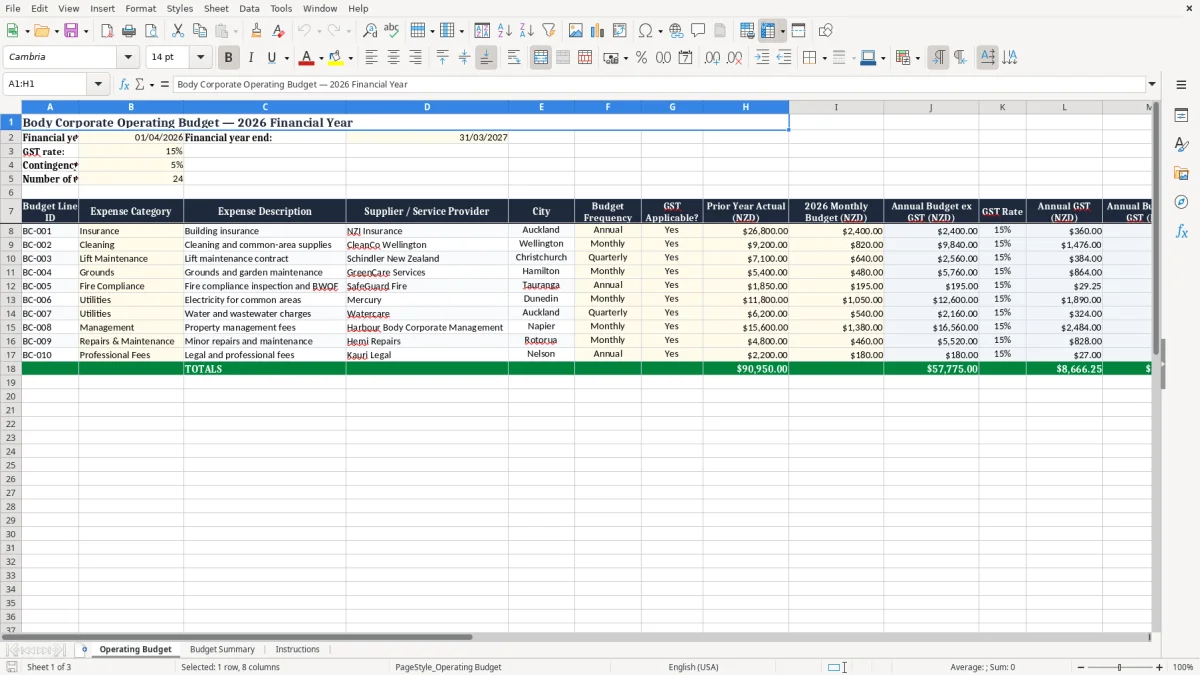
Plan and manage your body corporate finances with this New Zealand-focused operating budget Excel template. It helps committees, body corporate managers and owners forecast annual operating costs, calculate GST, compare the budget with prior-year actuals and estimate the levy contribution required from each unit.
The workbook uses New Zealand dollars and is set up for a financial year running from 1 April to 31 March. Enter your assumptions and expense lines to create a clearer view of expected operating expenditure, supplier costs and review priorities.
The key benefits of this Excel template
- Prepare a structured annual operating budget for a unit title development.
- Compare proposed costs with prior-year actual expenditure.
- Calculate GST and GST-inclusive totals using an editable GST rate.
- Identify material increases and reductions through dollar and percentage variances.
- Support levy planning with a number-of-units assumption.
- Record suppliers, review status and next review dates in one worksheet.
Step-by-step guide
Start by checking the financial year dates, GST rate, contingency rate and number of units. Add one row for each expected operating expense, including insurance, cleaning, gardening, utilities, maintenance, administration, compliance and professional services. Enter the supplier, city, budget frequency, GST treatment, prior-year actual and monthly budget amount.
Review the calculated annual budget excluding GST, annual GST and total including GST. Use the variance columns to investigate significant changes from the previous year, then assign a review status and next review date for important contracts and services. Before approval, compare the workbook with current invoices, supplier agreements, insurance renewals and the body's financial statements.
Confirm that operating expenditure is separated from long-term maintenance or capital expenditure where appropriate. The template is a planning tool, so the committee, body corporate manager and advisers should confirm the final assumptions and levy methodology.
Included features
Editable financial year start and end dates for the New Zealand financial year.
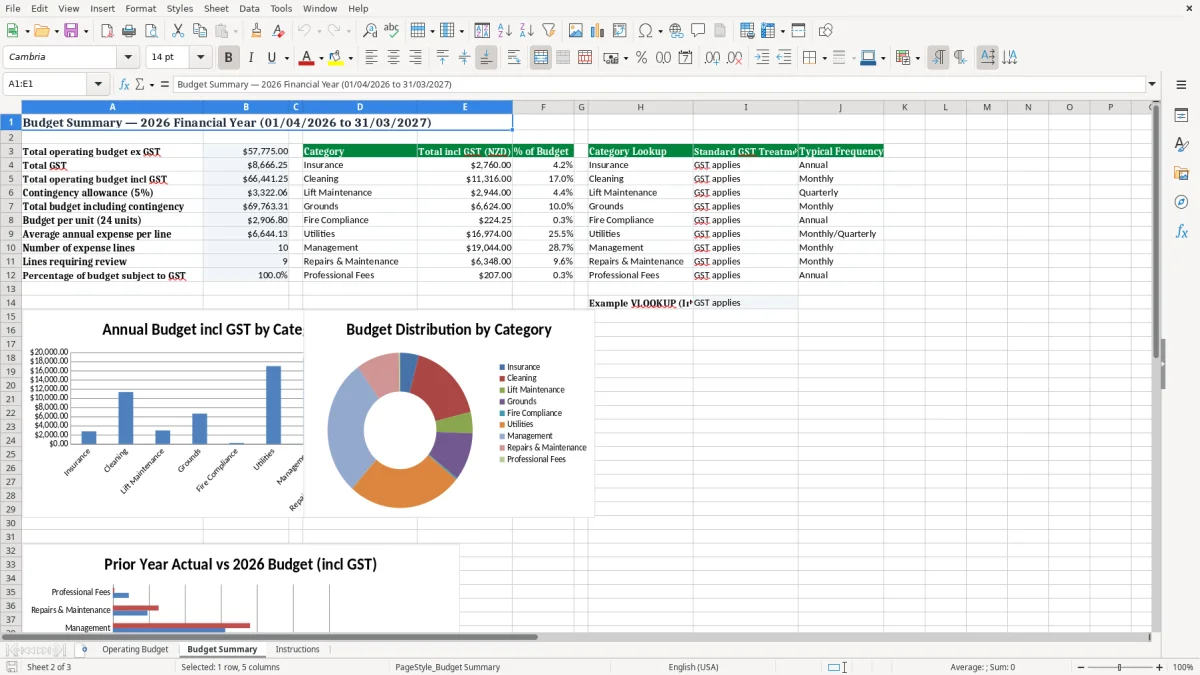
Assumptions for GST rate, contingency rate and number of units.
Budget line ID, expense category, description and supplier fields.
City, budget frequency and GST applicability fields for each expense.
Prior-year actual, monthly budget, annual ex-GST and GST-inclusive calculations.
Dollar variance, percentage variance, review status and next review date fields.
What is a body corporate operating budget?
A body corporate operating budget is a financial forecast for the recurring costs of running and maintaining shared property during a defined financial year. For a New Zealand unit title development, it can include building insurance, public liability insurance, cleaning, gardening, common-area electricity, water, rubbish collection, lift servicing, fire system maintenance, administration, accounting and body corporate management fees.
The budget gives the committee and owners a practical basis for reviewing expected expenditure and setting contributions or levies. This Excel template provides a consistent way to list each cost, identify the supplier and location, record the budget frequency, and compare the proposed amount with the prior year's actual result.
It also includes editable assumptions for GST, contingency and the number of units. The default financial year runs from 1 April to 31 March, reflecting a common New Zealand reporting cycle, but the dates can be changed when the development uses another approved period. A good operating budget should be based on current contracts, renewal notices, invoices and known changes in service levels.
It should distinguish predictable annual costs from variable repairs, call-outs and utilities. It should also make significant increases visible so they can be discussed before the budget is approved.
Operating expenditure is not always the same as long-term maintenance or capital expenditure. Major renewals and future projects may need to be managed through a separate long-term maintenance plan or capital works schedule. Use this template as a transparent planning and discussion document, then confirm classifications, GST treatment and levy allocation with the body's manager, accountant or other appropriately qualified adviser.
How to prepare a New Zealand body corporate budget
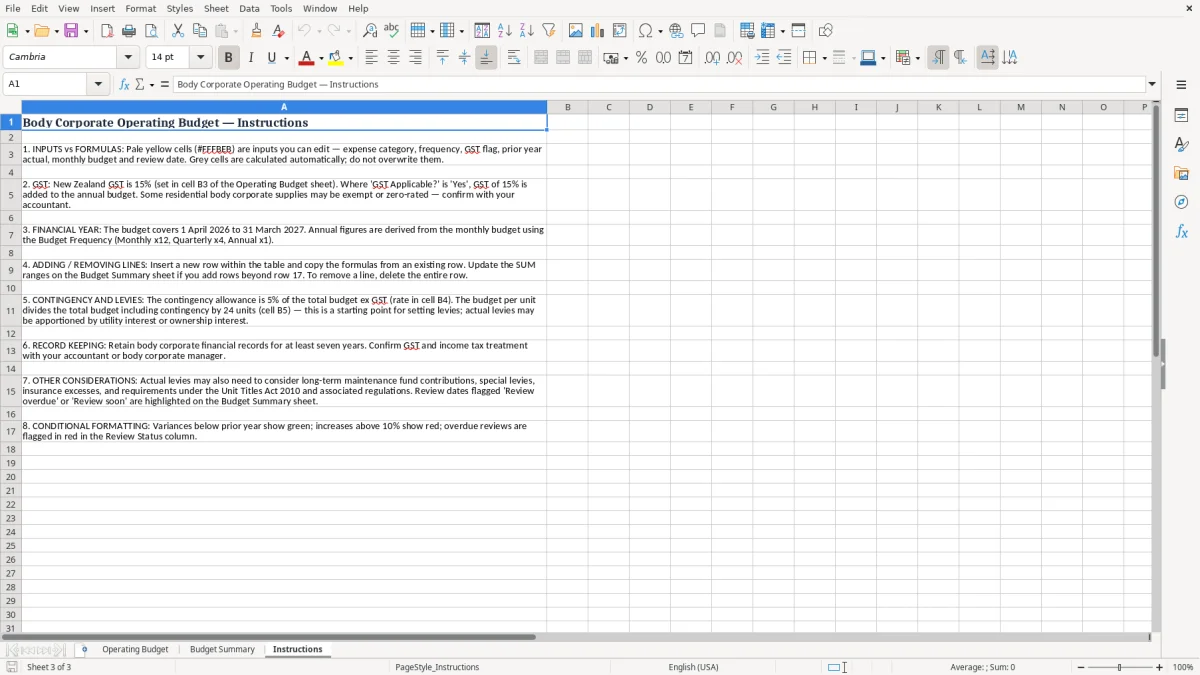
Preparing a body corporate operating budget is easier when costs are gathered and reviewed in a consistent order. Begin with the previous financial statements and identify every recurring expense. Then check contracts, invoices and renewal notices for the coming year.
Insurance is often one of the largest budget lines, so allow time to review the building policy, public liability cover, excesses and renewal premium. Add regular cleaning, gardening, waste, utilities and equipment servicing costs, followed by administration, accounting, legal, compliance and management fees.
For each item, record a clear description rather than using a vague label such as maintenance. A description like lift servicing, common-area lighting or annual fire compliance inspection makes future comparisons more useful. Enter the supplier or service provider and note the relevant city or location.
Select the budget frequency and indicate whether GST applies. The workbook uses the GST rate assumption to calculate annual GST and the total including GST, while the variance fields compare the current proposal with the prior-year actual.
If a cost is expected to rise, document the reason, such as an insurance renewal, contract increase, higher utility use or a planned service change. Include a reasonable contingency allowance for uncertain operating costs, but do not use contingency to hide known work. Confirm whether proposed amounts are operating expenses or should be funded through a long-term maintenance plan or separate project budget.
Finally, review the proposed total against available funds, expected levy income and applicable financial policies. The committee should discuss unusual variances and confirm the final budget before communicating levy information to owners. Professional advice may be appropriate where GST, allocation interests or statutory requirements are uncertain.
Where GST, allocation interests or statutory requirements are uncertain, a GST adjustments worksheet is the next step for confirming the amounts before the budget is finalised.
GST, levies and budget calculations
The template is designed for New Zealand budgeting and starts with a GST rate of 15 percent. This rate is editable because the correct treatment can depend on the body corporate's registration, the supplier's status and the nature of the expense.
Each budget line includes a GST applicable field so the workbook can distinguish costs that should have GST calculated from those that should not. Always verify the treatment of individual expenses with a qualified New Zealand accountant or tax adviser.
The annual budget excluding GST represents the forecast cost before GST. Annual GST is calculated for applicable lines, and the annual budget including GST shows the expected cash cost after GST. The variance to prior year is the difference between the proposed annual amount and the prior-year actual.
A positive variance generally indicates an increase, while a negative variance indicates a reduction. The variance percentage expresses that change relative to the prior-year result, although percentage results should be interpreted carefully when the previous amount is very small or zero.
The number-of-units assumption can help with an initial levy estimate by providing a simple per-unit reference. Actual body corporate levies may not be divided equally.
Allocation can depend on ownership interests, utility interests, operational rules, unit plan information, services used or other applicable requirements. The template therefore supports planning but does not determine the legally correct contribution for every development.
A contingency rate is included to provide an allowance for uncertain operating costs. It should supplement, not replace, a review of known repairs, renewals and compliance work.
Keep the operating budget separate from major capital expenditure and long-term maintenance funding where appropriate. Before approval, reconcile totals to proposed levy income, cash position, outstanding commitments and decisions made at a general meeting.
Tips for managing the approved operating budget
An approved budget is most useful when it remains a live management tool throughout the year. After each reporting period, compare actual expenditure with the budget and investigate material differences promptly.
A cost may be higher because of timing, an emergency repair, a supplier price increase, additional work or an error in coding. Recording the reason helps the committee make better forecasts and gives owners a clearer explanation of financial results.
Use the review status and next review date fields to manage important contracts. Insurance, cleaning, gardening, lift maintenance, fire systems, security monitoring and body corporate management agreements should have an identified owner and a documented renewal or review date.
Keep copies of quotes, invoices, contracts, policies and approval records with the financial files. When a supplier changes, update the supplier field and preserve the previous information in the body's records so future comparisons remain meaningful.
Review the contingency allowance during the year rather than assuming it will automatically cover every unexpected cost. If a major issue is discovered, decide whether it is ordinary operating expenditure, a planned long-term maintenance item or a separate capital project. Communicate significant changes and proposed levy impacts according to the body's governance processes.
At the next budget cycle, use actual results rather than simply copying the previous budget. Consider inflation, insurance market conditions, building age, maintenance history, service quality, compliance obligations and planned works. Check that all GST assumptions remain appropriate and that the financial year dates are correct.
The Excel template can support this process by providing a single structured record of expense lines, calculations and review actions. It does not replace meeting resolutions, statutory records, accounting systems or professional advice. Use it alongside those records to improve transparency, consistency and forward planning for owners and the body corporate committee.
Common questions about this template
It is a forecast of the recurring costs required to run and maintain shared property during a financial year. It supports expenditure planning, levy discussions and comparison of actual costs with the approved budget.
The workbook is set up for a New Zealand financial year from 1 April to 31 March. The start and end dates are editable if the development uses another approved reporting period.
Yes. The default GST rate is 15 percent, and the assumption can be changed. Confirm the GST treatment of each expense with a qualified New Zealand tax or accounting adviser.
The number-of-units assumption supports a simple levy planning reference. Actual levies may need to reflect ownership interests, utility interests, operational rules, services used and other applicable requirements.
The template is primarily for annual operating expenditure. Major renewals, future projects and capital works should generally be tracked in a separate long-term maintenance plan or capital works budget.
The committee and body corporate manager should review the assumptions, supplier costs, GST treatment, variances and funding. An accountant or other qualified adviser can provide additional review where needed.
Download
File format
Excel (.xlsx)
Compatible software
Excel, Google Sheets, LibreOffice
Price
Free